Explore the compelling reasons and process for migrating your eCommerce platform from Magento to Medusa.
Why is it worth migrating from Magento to Medusa?

While Magento has been a powerful solution for many e-commerce companies, it has created challenges that are driving more companies to look for more modern alternatives.
The decision to migrate from Magento to Medusa is driven by a multitude of factors that collectively enhance operational efficiency, reduce costs, and provide a better overall user experience for both developers and customers.
Below are the headline figures from our work and what they imply for teams switching platforms.
- Medusa is 6.5× faster.
- Medusa is ~2× more popular among developers.
- Magento can take up to 11× longer under heavy loads.
- ~21% of Magento stores have migrated since 2020.
- Maintenance and hiring for PHP platforms is becoming more expensive and time-consuming - the rate of progress for this framework is slower than JavaScript.
Using Medusa, businesses position themselves to respond more quickly to market changes, reduce long-term costs, and leverage modern development practices.
We asked Nicklas Gellner why he thinks a move from Magento to Medusa makes sense:

For a deeper dive into this comparison, see Section 8 of the guide!
What you'll find inside this whitepaper
- Modern eCommerce platforms expectations
- Market trends related to migration from Magento
- Insight into Magento challenges: Complexity, Performance, Flexibility, Support for open-source
- Magento vs. Medusa comparison: Performance, Architecture, Customization, Total cost of ownership, Developer experience
- Migration strategies: Phased or Big Bang Approach
- Phased migration with Medusa Modules
- Step-by-step migration process in 7 stages
- Successful migration case study
What to expect from modern e-commerce platforms in 2026?
Many companies using old monolithic platforms face performance bottlenecks, escalating costs, and limitations in flexibility. To address these challenges, new platforms have been developed with a modern tech stack and open-source software.
Today's eCommerce platforms need to have a variety of features to meet the demands of businesses and customers. Here are the main qualities to look for in a modern platform:
- Composable approach: A modular setup lets businesses build and tweak their tech stack with top-notch components, ensuring flexibility and avoiding being tied down to one vendor.
- Flexibility: It should allow for extensive customization and integration so businesses can adapt the platform to their specific needs.
- Developer-friendly environment: Using modern technologies should make development easier, reducing the learning curve and speeding up new features.
- Performance optimization: Fast load times and a smooth user experience are crucial for keeping customers happy and improving search engine rankings.
Explore more in Section 2 of the whitepaper!
Who is this guide for?
- CTOs planning the shift from Magento to modern eCommerce infrastructure
- Technical Leaders aiming to modernize the tech stack and enhance platform performance
- Founders looking to future-proof their eCommerce operations
- Operations & Marketplace Managers seeking to reduce infrastructure complexity and operating costs
- Procurement Teams evaluating pricing models, licensing terms, and long-term cost trade-offs
Migrate your online store to Medusa successfully like others
Patyna, Poland's largest vintage marketplace, successfully migrated with our team to Medusa, enhancing their platform's performance and reducing maintenance overhead. The platform supports 2,000+ vendors and features over 30,000 unique vintage pieces.
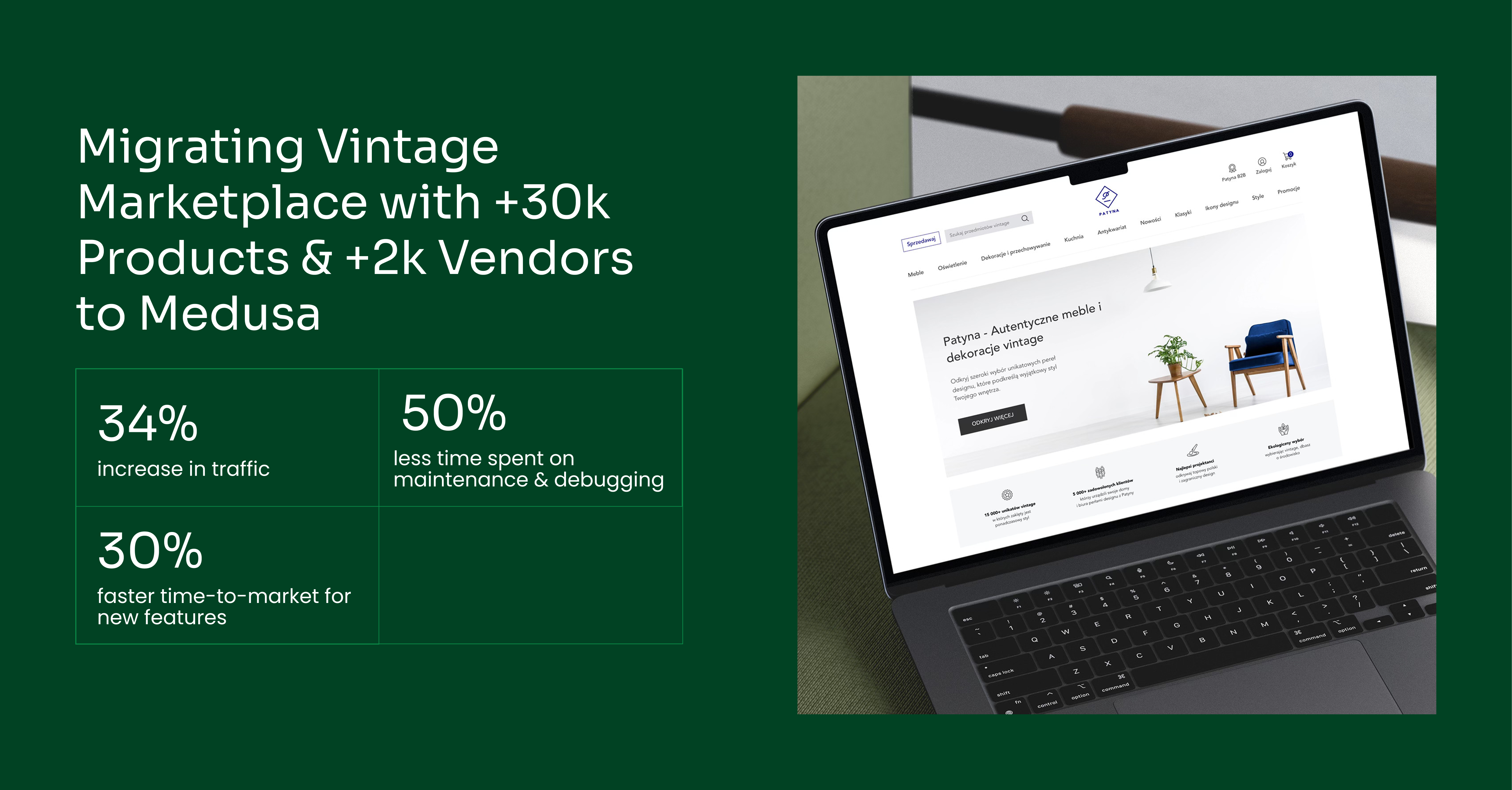
Section 19 of the whitepaper walks through this case study in depth. Read now!
Migration stages
When moving from Magento to Medusa, it's important to follow several key steps to ensure a smooth transition. Here’s how you can effectively manage this migration:
- Discovery and gap analysis: Assess your Magento setup to identify key components and features needed in Medusa. Perform a gap analysis to spot potential migration issues.
- Planning and roadmap development: Set clear migration goals and involve all stakeholders. Create a detailed plan with steps, timelines, and resources, including risk contingencies.
- Data extraction and mapping: Export data structure from Magento and map it to Medusa. Ensure compatibility, accuracy, and clean the data by removing duplicates and errors.
- Customizations and integrations: Replicate or enhance custom features in Medusa. Develop necessary plugins and integrate third-party services like payment gateways and CMSs.
- User interface migration: Rebuild the e-commerce frontend with frameworks like Next.js or Gatsby. Maintain design and functionality while optimizing performance.
- Testing and quality assurance: Test all functionalities, including the user interface and data migration integrity. Perform user acceptance testing and ensure the system handles traffic and stress.
- Go-live and post-migration support: Execute the go-live plan, transition to Medusa, and provide continuous support. Monitor the system, address issues, gather feedback, and make adjustments.
We break down this topic in detail in Sections 11-18 of the guide.